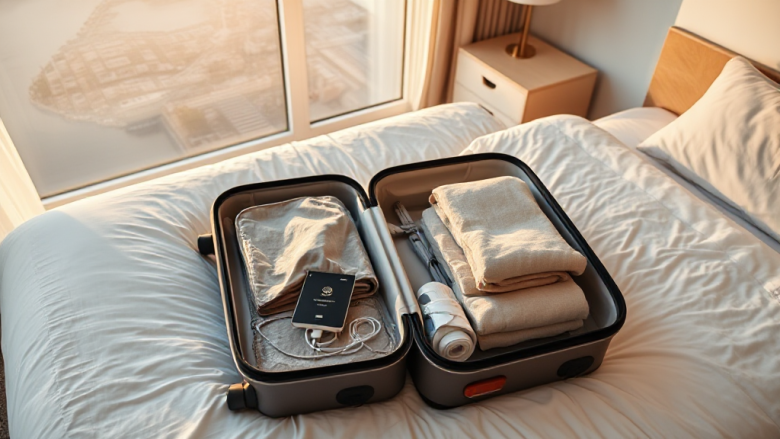
Set a timer for thirty minutes. That’s the whole trick. Travel packing for busy people isn’t about owning clever gear or folding like a shop assistant — it’s about refusing to let a suitcase eat your evening. The clock forces decisions, and decisions are what most people avoid when they pack. Thirty minutes is enough for a four-day work trip or a long weekend, provided you follow one rule: everything goes in one carry-on bag. No checked luggage, no second bag, no exceptions. If it doesn’t fit, it doesn’t come.
I travel most weeks for work and take short breaks whenever I can. I’ve packed at 11pm after a late meeting and at 5am before a flight, and the routine below is the one I keep coming back to. It’s boring, it’s fast, and it means I never stand at a baggage carousel again.
Before the timer starts: the two-minute setup
Don’t open the wardrobe yet. First, check the weather at your destination and the dress code for anything you can’t miss — a client meeting, a wedding, a dinner that isn’t jeans-friendly. Write those two things on a scrap of paper or a note on your phone. That’s your brief. Everything you pack has to answer to it.
Then put the bag on the bed, open and empty. An empty bag on a bed is a psychological signal: we’re doing this now, not later. Pick your bag before anything else. A soft-sided carry-on around 40 litres is the sweet spot for most trips of three to five days. Hard cases look tidy but waste space at the corners; soft bags squash into overhead bins on full flights, which matters more than you’d think.
Now start the timer.
Minutes 0–5: clothes, counted not chosen
The reason packing takes an hour is that people treat it as a styling exercise. It isn’t. It’s arithmetic. For a trip of up to five days, the core capsule is:
- Three tops that all work with every bottom
- Two bottoms — one smart enough for a meeting, one comfortable enough for a long walk
- One mid-layer: a jumper, cardigan or light fleece
- One outer layer: a packable rain shell or a blazer, depending on the trip
- Underwear and socks for each day, plus one spare of each
- One pair of shoes on your feet, one flat pair in the bag
- Sleepwear, if you don’t sleep in a T-shirt
Everything must match everything. If you’re holding a top and wondering what it goes with, it goes back in the drawer. That single rule is what keeps a small bag working for a week.
Pack the heaviest items along the spine of the bag, near the wheels or the back panel. Roll knitwear and T-shirts; fold anything that creases badly, like a shirt, and lay it flat on top. Shoes go sole-to-sole at the bottom, with socks stuffed inside them. Don’t overthink this. The five-minute limit means you’ll make the call and move on, which is exactly the point.
Minutes 5–12: toiletries and the liquids problem
Toiletries are where last-minute packers lose the most time and the most space. Decant what you actually use into small bottles a week or two before a trip — or, if you’re reading this the night before, accept that you’ll buy shampoo at the airport and pack only the things you can’t replace easily.
The essentials that earn their place in a one-bag setup: a clear liquids pouch with anything under 100ml, a toothbrush and a travel-sized paste, deodorant, a razor, and any medication in its original packaging. Everything else — full-size shampoo, a hairdryer, a towel — stays home unless the hotel genuinely won’t provide it. Most will.
Keep the pouch packed between trips. It’s the single biggest time-saver in this whole routine: a bag that’s already full of the boring stuff means you only ever pack clothes and electronics. If you take nothing else from this article, take that.
Minutes 12–20: tech, documents and the small stuff
This is the section people forget, then remember at the gate. Work through it in order.
Chargers first: phone, laptop, watch, headphones. Then a plug adapter if you’re crossing a border with different sockets, and a small power bank. Cables go in one pouch or one zip pocket — never loose in the main compartment, where they tangle with everything and vanish when you need them.
Documents next, and this is non-negotiable: passport or ID, boarding pass if you’re not using a phone, any visa paperwork, travel insurance details, and the address of where you’re staying on the first night. Keep them in one flat pocket you can reach without opening the whole bag. If your phone dies, you still need to know where you’re going.
Then the small stuff that quietly ruins trips when it’s missing: painkillers, plasters, a spare contact lens case, glasses if you wear them, a pen for landing cards, and a foldable tote for laundry or shopping. That tote takes up almost no space and gets used on nearly every trip.
Minutes 20–27: wear the bulky things
Whatever takes the most space on your body, not in your bag. Flights are cold, airports are cold, and a coat worn through security is a coat you didn’t have to fold. The same goes for your heaviest shoes. If you’re flying somewhere warm, wear the trainers and pack the sandals; if you’re flying somewhere cold, wear the boots and pack the lighter pair.
Dress in layers you can shed: a T-shirt, a mid-layer, and the jacket. You’ll be comfortable on the plane, and you’ve effectively added a day’s worth of clothing capacity to your bag at no cost.
Minutes 27–30: the final sweep
Zip the bag, then do one lap of the room with a fixed list in your head. Phone. Wallet. Keys. Passport. Medication. Charger. That’s the sweep — six things, in that order, every time. It takes ninety seconds and it catches almost everything people leave behind.
Then stop. Don’t reopen the bag to add one more jumper. The timer exists to protect you from yourself. If something’s genuinely missing, you’ll buy it there, and it will cost less than the hour you’d otherwise spend second-guessing a suitcase.
Why the one-bag rule does the heavy lifting
Every packing problem is really a decision problem. A bigger bag doesn’t solve it; it just delays the decision until you’re standing in a hotel room wondering why you brought three pairs of jeans. One bag sets a hard limit, and hard limits make you fast. You stop asking whether you might need something and start asking whether you’ll definitely use it. Most of the time, the answer is no.
There’s a second benefit that matters more on busy weeks: no checked luggage means no carousel, no lost-bag queue, no waiting. You walk off the plane and out of the airport. On a tight schedule, that’s often the difference between making an evening meeting and missing it.
It also changes what you pack over time. After a few trips with the same capsule, you notice what you never wore. Those items quietly leave the rotation. Within a couple of months, the thirty-minute routine becomes a fifteen-minute one, because the bag is already half-packed and the decisions are already made.
The mini checklist to keep on your phone
Screenshot this and stop rebuilding it every time. Clothes: three tops, two bottoms, one mid-layer, one outer layer, underwear and socks with a spare, sleepwear, two pairs of shoes. Toiletries: pre-packed liquids pouch, toothbrush, deodorant, razor, medication. Tech: chargers, adapter, power bank, cable pouch, headphones. Documents: passport or ID, boarding pass, insurance, first-night address. Small stuff: painkillers, plasters, glasses, pen, foldable tote. On your body: heaviest coat, heaviest shoes, layers.
That’s the whole system. Thirty minutes, one bag, six things in the final sweep. Pack the night before if you can, but if you can’t — and with a schedule like yours, you often can’t — the timer still works at 5am. Set it, work through the order, zip the bag, and go. The trip is the point, not the packing.