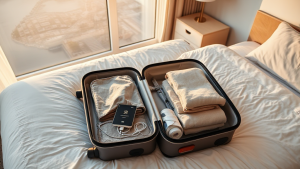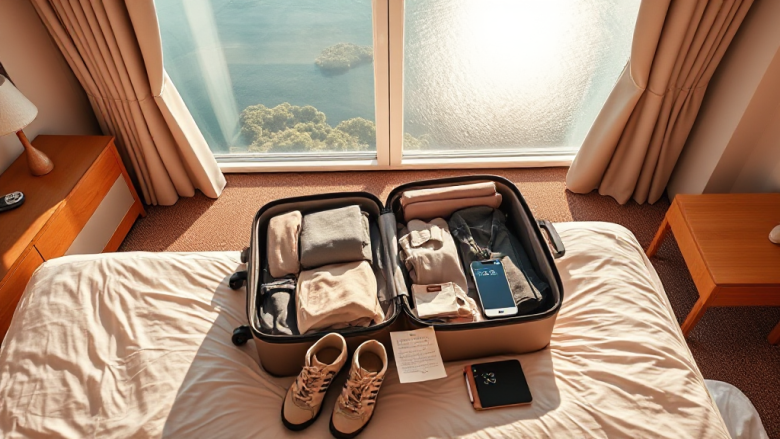
Set a timer for 30 minutes. That’s the whole trick. Travel packing for busy people isn’t about having more free time than everyone else — it’s about refusing to let packing expand to fill whatever time you give it. Give it half an hour, work in strict blocks, and you’ll close the case before the timer beeps. I’ve tested this on red-eye flights booked the same afternoon, on weekend trips squeezed between work deadlines, and on a five-day conference where I packed at 11pm the night before. It holds up.
The method rests on three ideas: decide fast, gather in piles, and pack in one direction. No outfit planning sessions. No spreadsheet of every charger you own. Just a timed sequence that gets you out the door with everything you actually need. Here’s how the 30 minutes break down.
Minutes 0–5: Decide the Trip Shape
Before you touch a bag, answer four questions out loud. How many days? What’s the weather range? What’s the dress code — smart, casual, or a mix? And is there laundry access at the other end? Write the answers on a sticky note or the back of an envelope. This takes three minutes if you don’t overthink it, and it prevents the two most common packing failures: bringing four pairs of shoes for a two-day trip, and arriving somewhere cold in a linen shirt.
The trip shape also tells you which bag to use. Two nights, one city, no formal events: a carry-on backpack. Five nights with a wedding in the middle: a wheeled cabin case plus a small personal bag. Ten days with a washing machine at the hotel: still a cabin case, because you’ll do laundry on day four. The default assumption for a busy person should always be carry-on only. It saves you the check-in queue, the baggage carousel wait, and the risk of a lost bag derailing the whole trip. If you can’t fit it in a cabin bag, you’re probably packing for a trip you’re not taking.
While you’re deciding, check one practical thing: the airline’s cabin allowance for your specific fare. Basic fares on some carriers allow only a small underseat bag, not a full cabin case. Knowing this in minute three saves an expensive surprise at the gate.
Minutes 5–15: Build the Three Piles
Now the physical work. Empty your bag on the bed, or better, clear a space on the floor. You’re making three piles, and every item you consider goes into exactly one of them.
Pile one: the core capsule. This is the clothing you’ll actually wear, built around a single colour scheme so everything matches. For a typical three-to-five day trip, that means three tops, two bottoms, one mid-layer, one weatherproof outer layer, five to seven pairs of underwear and socks, one set of sleepwear, and one pair of shoes you’re not already wearing. That’s it. Not four tops “just in case.” Not a third pair of trousers because you might spill something. The capsule works because every top goes with every bottom, which means you can dress for any combination of weather and occasion without a single wasted item.
Two rules keep the capsule honest. First, lay each item flat and ask whether you wore it in the last two weeks at home. If not, it stays. Second, roll, don’t fold. Rolling compresses clothes into less space and reduces creasing, and it lets you see everything at a glance once the bag is packed.
Pile two: the essentials pouch. Passport or ID, phone, charger, power bank, any medication, toothbrush and a travel-size toothpaste, deodorant, and a small bag of toiletries you’ll actually use. Keep this pile small enough to live in one pouch. The pouch goes in your personal bag, never in the hold, so a delayed suitcase never means a night without your medication or a dead phone.
Pile three: the maybe pile. Everything you’re tempted to bring but haven’t justified. The extra jumper. The second book. The hair dryer the hotel almost certainly provides. The gym kit for a trip with no gym slot. Leave this pile on the floor. At the end of the 30 minutes, you’ll put most of it back in the wardrobe, and you won’t miss any of it. If you’re genuinely unsure about one item, ask whether you could buy it at your destination for under the price of a checked bag. If yes, leave it.
Fifteen minutes is enough for all three piles if you resist the urge to try things on. You know your clothes. Trust that.
Minutes 15–25: Pack in One Direction
Packing is not a creative exercise. Work from the bottom of the bag to the top, heaviest items first, and don’t reorganise halfway through.
Start with shoes. Two pairs maximum, including the ones on your feet. Stuff socks or a charging cable inside each shoe to use the dead space, then place them sole-down at the base of the bag where their weight sits over the wheels. Next, the rolled clothing capsule, packed tight against each other so nothing shifts in transit. Trousers and any structured items go on top of the rolls, folded once, not twice. Toiletries and liquids sit in a sealed pouch near the top or in an outside pocket where you can reach them at security without unpacking the whole case.
Then the small stuff. Chargers and adapters in one pouch, not scattered across three pockets. A single bag for cables means you’ll never spend twenty minutes at a hotel desk hunting for the one that fits your laptop. If you take a laptop, it goes in the personal bag, flat against your back, not in the cabin case where it adds weight you’ll feel on every escalator.
One more habit worth building: leave a little empty space. A bag packed to bursting is a bag that’s hard to close, hard to carry, and impossible to add a souvenir to. Ten percent breathing room is the difference between a calm departure and a wrestling match on the bedroom floor.
If you’re flying and want to skip the security shuffle entirely, put your liquids pouch and your laptop in the top layer of your personal bag the night before. You’ll sail through the checkpoint while everyone else unpacks their entire life into a plastic tray.
Minutes 25–30: The Mini Checklist and the Door
The last five minutes are for the things people actually forget. Run this short list once, out loud, touching each item as you confirm it.
Passport or ID. Phone and charger. Wallet and cards. Medication. Keys. Tickets or boarding passes, saved offline in case the signal drops. That’s the list. Six items, thirty seconds, and it catches almost every real packing disaster. Everything else — the forgotten toothbrush, the missing adapter — can be solved at a pharmacy or a hotel desk for a few pounds.
Then zip the bag, put it by the door, and set an alarm. Do not reopen it. The urge to add “one more thing” at minute 29 is the enemy of the whole method. If you’ve followed the blocks, you’re already carrying more than you’ll use. Trust the timer.
The real value of this routine isn’t the half hour you save on the night before a trip. It’s what happens on the trip itself. A capsule that all matches means you stop thinking about what to wear and start thinking about where you’re going. A bag you packed in one direction means you can repack it in five minutes on the last morning. And a routine you’ve run three or four times becomes muscle memory — the kind of thing you can do while half-listening to a podcast, which is exactly how packing for busy people should feel.
Keep the sticky note from minute zero. Next trip, you’ll fill it in faster, and the 30 minutes will shrink to 20. That’s the whole point. Packing isn’t a project. It’s a short, sharp task you do on the way to something better.