The best beginner adventure is the one you can actually book this month. Not the one that sounds impressive at a dinner party, not the one that needs six months of training and a small fortune in kit. The one that fits a free weekend, a modest budget and whatever level of fitness you happen to have right now. That’s the honest starting point, and it’s why this comparison looks at the best outdoor adventures for beginners in the UK through a simple lens: how much effort does each one demand, and what do you get back for it?
Britain is unusually well suited to this. You can stand on a mountain summit, paddle a quiet estuary, sleep in a woodland hammock and cycle a disused railway line, all within a few hours of most major cities. The trick is matching the activity to your appetite on the day. Some options reward you within two hours. Others take a full weekend but leave a deeper mark. Below are eight realistic starting points, compared by difficulty, cost and season, so you can pick one and get on with it.
How to Judge a Beginner Adventure Fairly
Difficulty in the outdoors is rarely about raw physical effort. It’s usually about three quieter things: navigation, exposure and commitment. A flat ten-mile walk with clear waymarking is easier than a three-mile scramble where you have to read the map and the weather constantly. Exposure matters too, because a ridge in high wind feels far harder than the same gradient in a sheltered valley. Commitment is the one people underestimate. Once you’re halfway up a mountain, turning back costs as much as pressing on.
For beginners, the smartest choices keep commitment low. That means routes with escape options, activities where a guide or instructor carries the decision-making, and gear you can hire rather than buy. Cost also varies more than most people expect. A guided coasteering session can cost more than a whole weekend of wild camping, yet the camping trip requires more confidence and better planning. Neither is better. They’re just different trades of money against self-reliance.
Season is the last variable, and in the UK it’s the one that catches people out. Coastal activities often work best in late spring and early autumn, when the water is still cold but the crowds have gone. Inland hills are at their kindest from May to September. Anything involving rivers, gorges or sea caves depends heavily on rainfall in the preceding days, so flexibility beats fixed plans.
Gentle Water: Kayaking, Canoeing and Paddleboarding
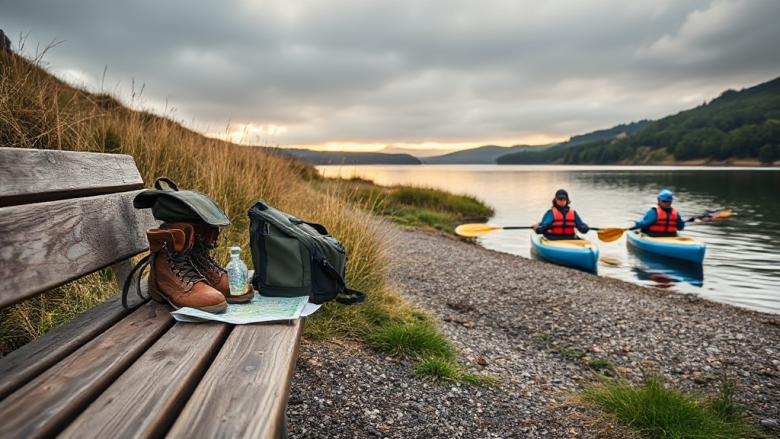
Flat water is the most forgiving introduction to the outdoors you can find. Sit-on-top kayaks and inflatable paddleboards are stable, cheap to hire and almost impossible to get badly wrong on a calm canal or sheltered lake. A two-hour taster session typically costs between twenty-five and fifty pounds, including buoyancy aid and paddle, and most centres run them from Easter through October.
The reward is immediate. You’re on the water within fifteen minutes of arriving, and the perspective shift is genuinely surprising. A canal you’ve driven past a hundred times becomes a slow, quiet corridor of herons and moored boats. The main skills to learn are basic forward paddling, turning and how to get back on if you fall in, which is worth practising deliberately rather than discovering by accident.
Difficulty sits at the lowest end of the scale, assuming you can swim and the weather is reasonable. Cost is low to moderate. Season runs spring to early autumn, though hardy paddlers continue through winter on sheltered inland water with the right clothing. This is the activity to choose if you want a taste of adventure with almost no risk of a bad day.
Coasteering: Big Thrills With a Safety Net
Coasteering is the odd one out on this list because it looks far more extreme than it is. You scramble along a rocky shoreline, jump into deep water, swim short distances and clamber back out, all in a wetsuit, helmet and buoyancy aid, with a qualified guide reading the swell and choosing the jumps. Pembrokeshire and the Cornish coast are the classic locations, but you’ll find operators along most of the south-west, west Wales and parts of Scotland.
The genius of it for beginners is that the guide removes almost all the decision-making. You don’t need to judge wave height or water depth. You just need to follow instructions and be willing to get cold and wet. Sessions last two to three hours and cost roughly forty-five to seventy pounds. You need reasonable mobility and confidence in the sea, but no experience whatsoever.
Season is the constraint. Most operators run from April to October, with the warmest and calmest conditions in July and August. It’s a brilliant choice if you want adrenaline without a long learning curve, and a poor choice if you dislike cold water or being out of your depth.
Lowland Walking and Long-Distance Paths
Walking is the most accessible adventure in the UK and the easiest to underestimate. The mistake beginners make is starting with a mountain. A better first step is a waymarked long-distance path section, such as a stretch of the South Downs Way, the Ridgeway or the Thames Path, where the navigation is simple and villages with pubs and buses break the route into manageable pieces.
Cost is close to zero beyond transport and a decent pair of shoes. Difficulty depends entirely on distance and ascent, both of which you control. A ten-mile flat day is a genuine achievement for a new walker and a pleasant afternoon for an experienced one. Season is year-round, though winter daylight is short and mud is a real factor on clay soils.
The reward here is cumulative rather than dramatic. You finish a section, look at the map and realise you’ve crossed a whole county on foot. That quiet satisfaction is why walking converts so many people into regular outdoor people.
Cycling Traffic-Free Trails and Old Railway Lines
Britain has an underrated network of traffic-free cycle paths built on disused railway lines, and they’re close to ideal for beginners. Gentle gradients, smooth surfaces and no cars mean you can focus on riding rather than surviving. The Camel Trail in Cornwall, the Tissington Trail in the Peak District and the Monsal Trail are well-known examples, but similar routes exist across Wales, Scotland and the north of England.
Hiring a bike costs around fifteen to thirty pounds for half a day, which makes this one of the cheapest ways to cover serious distance. A comfortable twenty-mile ride is very achievable for a moderately fit adult on a flat trail. Difficulty is low, though saddle soreness is a genuine and under-discussed factor on a first long ride.
Season runs all year, with summer weekends being busy and spring and autumn offering the best combination of quiet trails and decent weather. This is the activity to pick if you like the idea of covering ground and seeing several villages in a day without much physical risk.
Gorge Walking, Wild Camping and the Next Step Up
Once you’ve tried one or two of the gentler options, a few activities sit just beyond the beginner line but remain very achievable with a guide or a friend who knows what they’re doing. Gorge walking, sometimes called canyoning, involves scrambling up a stream in a wetsuit, often with a short abseil. It’s wet, noisy and enormous fun, and guided sessions cost roughly fifty to eighty pounds. Season is late spring to early autumn.
Wild camping is the other natural next step, though it requires more care. In England and Wales it’s generally only permitted with the landowner’s permission, while Scotland has more permissive rules under responsible access legislation. A first trip is best done in summer, on low ground, close to a road, with borrowed kit. The point isn’t to prove anything. It’s to learn how your body and your gear behave over a night outdoors.
Difficulty here is moderate, mostly because of planning rather than physical demand. Cost can be very low if you borrow equipment, or surprisingly high if you buy everything new for a single trip. Season is firmly summer for a first attempt.
Quick Comparison: Matching the Adventure to Your Weekend
Here’s the short version. Paddleboarding and kayaking are the lowest-effort, lowest-cost entry point and work from spring to autumn. Coasteering delivers the biggest thrill per hour with a guide doing the thinking, but it’s seasonal and sea-dependent. Lowland walking is free, year-round and scales to any fitness level. Traffic-free cycling covers the most ground for the least money. Gorge walking and wild camping are the step up, best attempted with guidance or experience alongside you.
| Activity | Difficulty | Typical Cost | Best Season |
|---|---|---|---|
| Kayaking or paddleboarding | Low | £25–£50 per session | April–October |
| Coasteering | Low to moderate | £45–£70 per session | April–October |
| Lowland walking | Low | Near zero | Year-round |
| Traffic-free cycling | Low | £15–£30 per half day | Year-round |
| Gorge walking | Moderate | £50–£80 per session | May–September |
| Wild camping | Moderate | Low if borrowing kit | June–August |
Read that table as a menu, not a ranking. The right choice depends on whether you’d rather be cold and exhilarated, warm and walking, or somewhere in between. If you’re genuinely unsure, pick the cheapest option that appeals and book it for a date within the next three weeks. Momentum matters more than optimisation at this stage, and almost everyone who becomes a regular outdoor person started with something modest that happened to be convenient.
The UK rewards low expectations and reasonable preparation. Take a waterproof, tell someone where you’re going, hire gear before you buy it, and treat the first attempt as a scouting trip rather than a test. Do that, and the second adventure books itself.